


As our industry constantly evolves with airlines and rail companies requesting ever more innovative products, we are seeing commercial, design, product development and sustainability teams working together in joint projects to present the best solutions. But does it really work? And, if so, how?
Simon Soni, former Guest Experience Director at WestJet, based in Canada, and Inflight Consultant, describes himself as a ‘changemaker in product and operations’, and to all accounts this is what he continues to do.
I asked him what he considers to be the main factors to be addressed by both airlines and suppliers when introducing a new onboard service. His frank opening gambit was: “Honesty and realism are really important. If, for example, the aim is to save money through the process or to save weight, then it is important to know the baseline and share this information with the prospective suppliers to avoid unnecessary re-work. This ensures that there is goal alignment between all parties involved.”
Project overview
It seems that the process of relaunching an onboard service falls into two categories.
If an airline is big enough to have an in-house development and creative team, they tend to create a detailed brief covering the exact look and feel that they want and then run a tender for each element. In this case, it is up to the airline to ensure the coherence of the whole project which requires a lot of work and, at best, in-house design thinking to help ensure that the result looks and feels good.
This process is time consuming, but does mean that the airline can potentially choose the best mix of suppliers including the best specialist suppliers for each element and can ideally control price and delivery options.
Louise Leaupepe, Inflight Experience Senior Manager at Riyadh Air says the key is constant communication. The key is in the brief and the collaboration that the airline has with each supplier to ensure cohesiveness and connection for the final inflight product,” she says. “And if the same people are managing all the product development within the airline they can make sure that a strong brand identity comes through with all the inflight product.
“Often, each supplier specialises in a particular area or product and so for the airline it makes sense to leverage each supplier’s particular strengths, even though it means managing multiple suppliers’ product development.
“Working really closely, with constant communication between ourselves and the suppliers’ design teams, ensures that we will end up with product that has the same design language, is fit for purpose; and provides value to our guests.”
Meanwhile, for those airlines that don’t have an in-house design and development team (or whose team don’t have the bandwidth) they may choose to pitch their requirement to the bigger design and development houses who can provide complete solutions and who can use their in-house design expertise to provide an end-to-end solution. This is likely to mean that the airline doesn’t have the opportunity to gain specialist input on each element as they are potentially restricted to the range from that company they’re working with.
It is still the case, however, that the airline can insist on specific control on the elements it chooses.

Wayne Costigan, Managing Partner at Global-c, is reminded of the time in 2018 he was part of a multiple supplier collaboration for the WestJet full service launch, and when Simon Soni set up a closed workshop with Formia, Sola, Clip, Watermark (then Galileo Watermark) and Global-c to ensure they all fully understood his remit and worked together.
Hans Engels of leading cutlery specialist Sola says: “Ideally the airline and the individual suppliers should sit down together to discuss the objectives and options. However, in a highly competitive market this is rarely the case.
“As a cutlery supplier, we have no interest in supplying plates or glasses but it is imperative that we see them so that we can match them with the right cutlery.
“This was particularly apparent in our recent work with Air India, which made all the decisions in-house using a number of specialist suppliers including Global-c for serviceware, Buzz for amenities, Kaelis for duvets and us as the cutlery specialist. I believe collaboration is essential for the best outcome, but it remains a serious challenge”
Wayne concurs: “The Air India project with Sola was not really a collaboration as the customer made independent design decisions and kept us at arm’s length. That said, the result was fantastic and we will think seriously about future collaboration with Sola.
“Sola is the undisputed leader in aviation flatware, and our aim is to become the go-to company for bespoke tableware programmes, so a future partnership makes sense.”
Collaboration innovation
“Collaboration is part of our core DNA, and my team exhibits this on a daily basis, not only internally but throughout our entire supply chain, including competing suppliers,” says Mark Russell, Linstol CEO.
“We pride ourselves on being not just experts in our field, but also highly flexible and efficient collaborators. We understand the importance of creating a cohesive product, even when multiple suppliers are involved. Behind the scenes, we engage in extensive collaboration to ensure all elements align seamlessly. This includes uniform product design, co-packing, and sophisticated logistical coordination.
“It is certainly more efficient for us to control the entire supply chain of all components of a product but in instances where the airline brief requests a collaboration between suppliers we have partnered with other suppliers to create a single passenger product with a cohesive story.
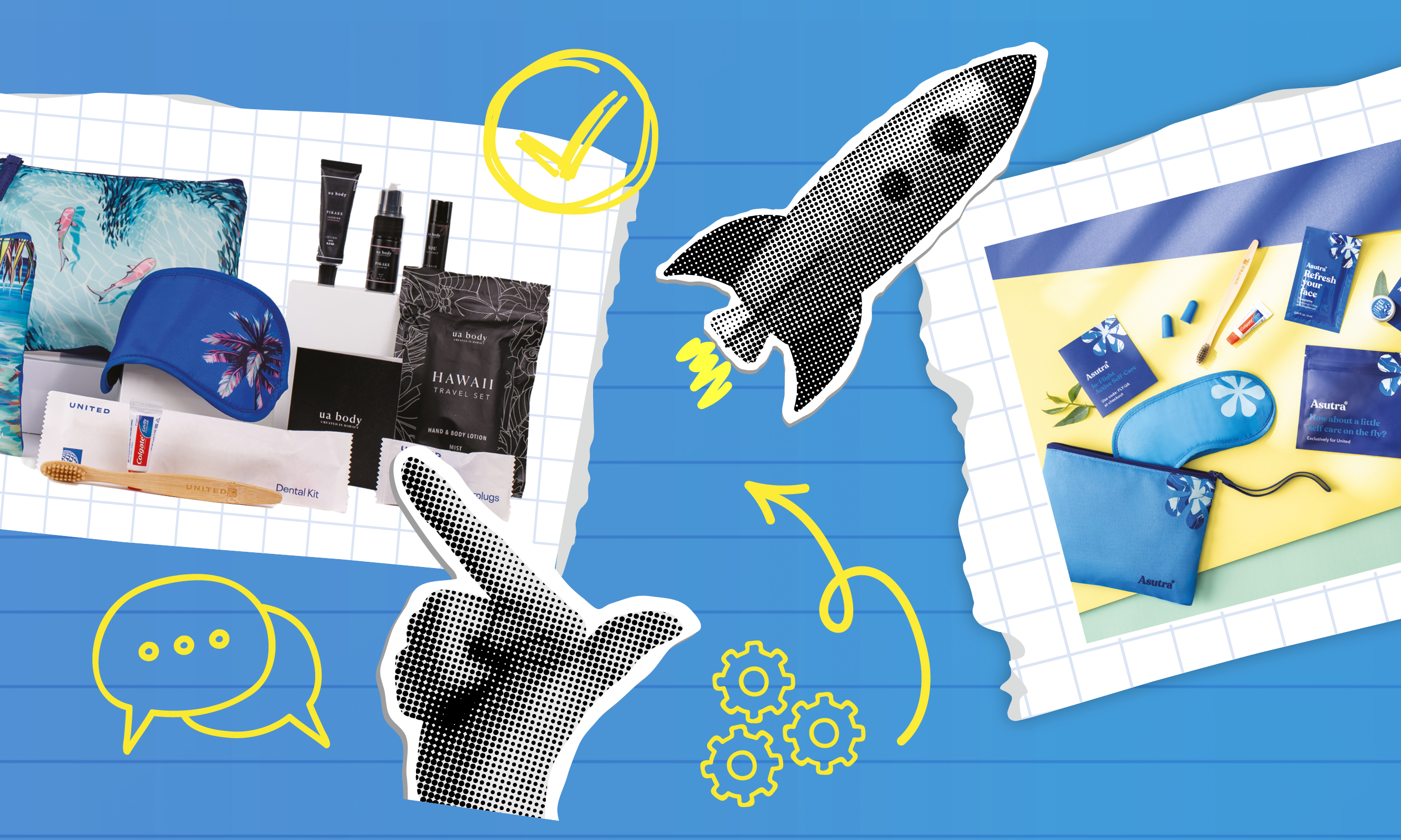
“For example, Linstol recently worked with United on the development of a unique amenity kit for their Hawaii routes. Collaboration on this kit including working with United on the overall concept, Artist Christie Shinn on the artwork featured on the bag, and Wessco International on the UA body amenities featured inside the kit.
“When it comes to collaborating on amenity kits, there are many, many moving parts involved and it takes a highly skilled and diverse team to pull it off successfully,” concludes Mark.
Team effort
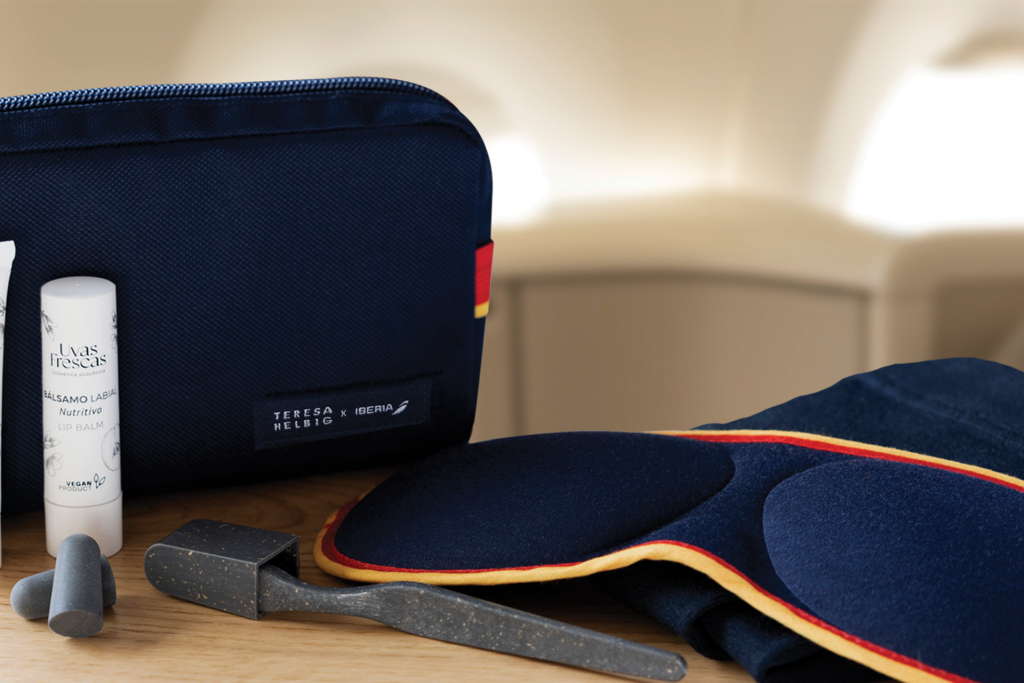
In the case of Iberia’s recent upgrade of its inflight service across all cabins it was a real team effort.
On amenities alone, to create the effect it wanted the airline chose to work with Kaelis, Araex, Uvas Freto.
Melanie Berry, Customer Experience Director at Iberia says: “We are promoting initiatives to offer a more sustainable travel experience and this includes the new amenity kits that we offer our Business and Premium Economy customers on long-haul flights.
“This is a global circular economy project with which we improve the management of our waste generated onboard, value Spanish talent and contribute to labour inclusion.
“These sustainable amenity kits, designed by Spanish award-winning fashion designer Teresa Helbig, include natural and vegan cosmetic products made in Spain by Uvas Frescas with surplus grapes from the production of the wines we serve onboard. In addition, the packaging is made from sugar cane and packaged in the special employment centre of Envera, the association of disabled employees with which Iberia has been working for more than 40 years. The project was co-ordinated by Kaelis, culminating in a truly Spanish collaboration.”
Commenting on the project Manoj Pridhanani, Chief Design Officer at Madrid-based Kaelis adds: “Working with Iberia on this project has been an absolute dream come true! I vividly remember the launch of their new uniforms and thinking “Wow, how amazing would it be to collaborate on something so iconic. Fast forward to today and here we are, with passengers raving about the experience onboard Iberia flights. The amenity kit we crafted is all about elevating that inflight experience, and this one does just that by blending sophistication, style and sustainability.”
Partner to thrive
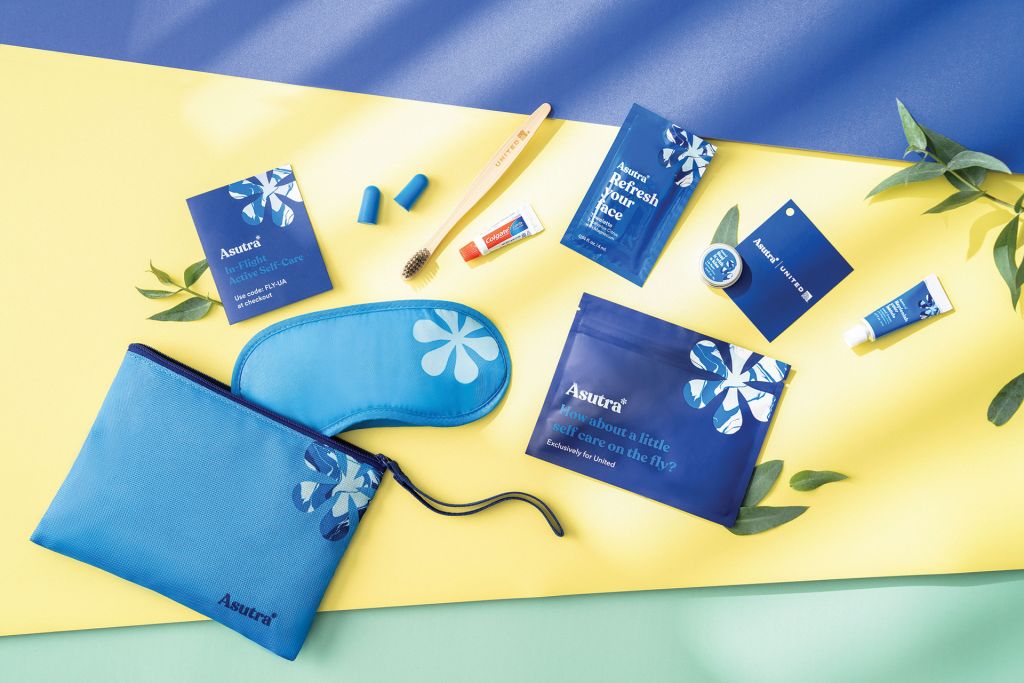
Meanwhile, Chicago-based Procurall Solutions also collaborated on a recent project with United and Asutra, a wellness brand championed by Venus Williams, to provide a self-care amenity kit.
Jennifer Green, President and Co-Founder of Procurall says: “This strategic partnership highlights the visionary leadership United Airlines is known for, along with the wellness expertise of Asutra, both complemented by Procurall’s eco-conscious solutions.
“Our industry thrives on partnership. At Procurall we are dedicated to nurturing collaborations that elevate the passenger experience.
“While airlines often work with various suppliers, the magic happens when these suppliers synergise to transform individual elements into a unified passenger journey. The more an airline shares its vision and objectives, the better we can align and bring that vision to life. Once suppliers are shortlisted, airlines should consider uniting them in a collaborative workshop. This strategic approach turns separate product launches into a cohesive cabin debut, leveraging collective strengths to create exceptional outcomes.”
A final thought from Holly Bhakar, Head of Product at Plane Talking Products: “Collaborating brings together a diversity of thoughts, perspectives and ideas, uplifting creativity and innovative solutions that might not emerge when working alone. Whether it is collaborating indirectly through a project leader within the airline, or suppliers coordinating other suppliers, brands, manufacturers, or agencies to offer a unique and cohesive range of products that work together to add value to the overall passenger experience, competitor collaboration is certainly an overlooked opportunity within our industry.
At face value it can sound counterintuitive, however the key is to identify complementary strengths which when combined create a more powerful offer.
“Here at PTP we have found our greatest successes by thinking outside of the box and bringing together teams and creating alliances formed from kindred backgrounds, experience, and expertise, and combining with our own, to all work towards a common objective.
“Collaboration is key when working towards our joint strategic goals of enhancing the passenger experience. A well joined-up approach can result in unlikely yet groundbreaking collaborations that really shake up and excite the industry”.


