


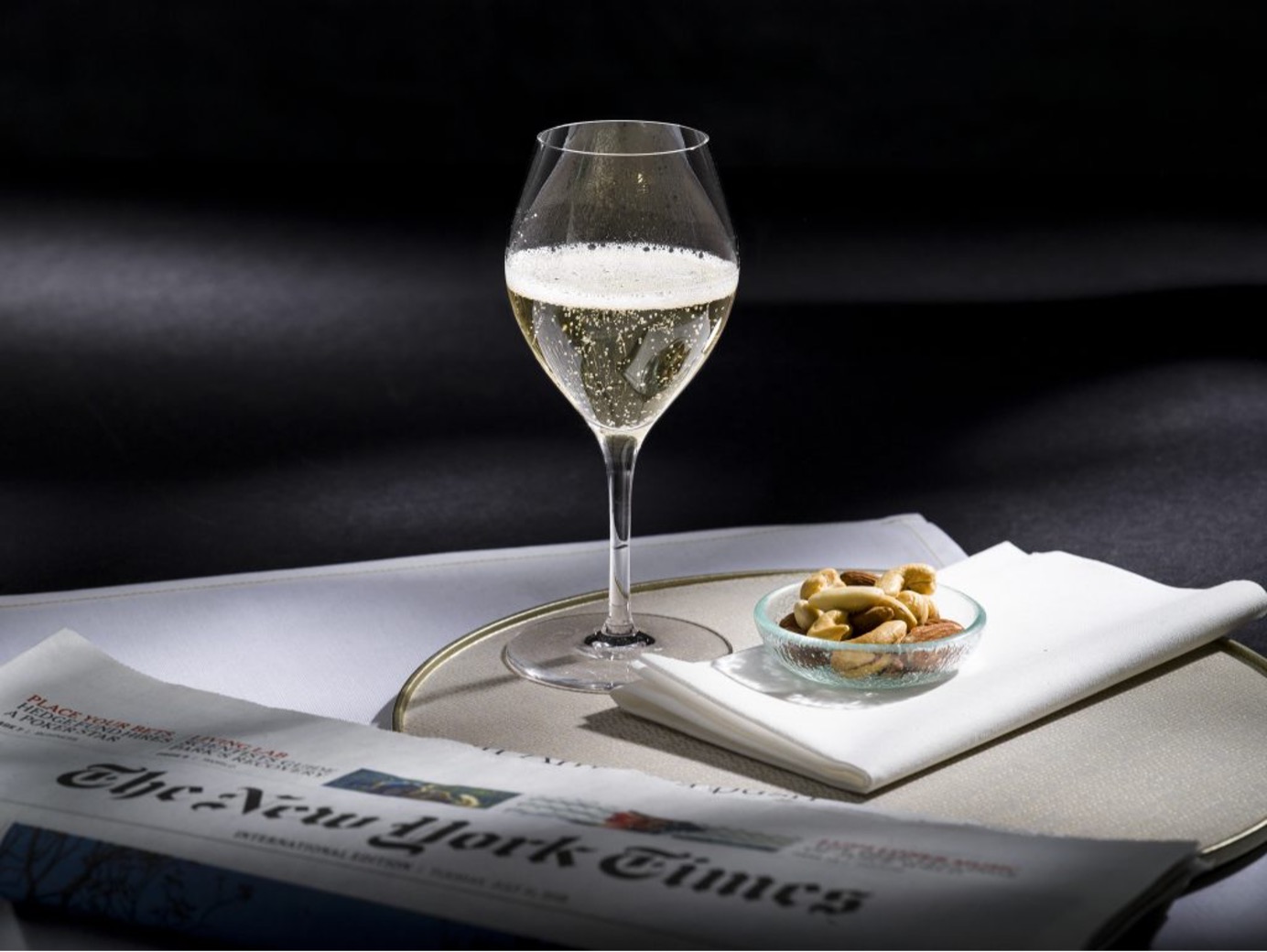
On a typical galley loading plan, glassware is one of the smallest line items. Onboard, it is the object a premium passenger holds longer, touches more often, and photographs more frequently than almost anything else in the cabin. That asymmetry of a minimal share of the budget, a maximal share of perceived quality is why drinkware deserves a closer look from procurement teams than it usually gets.
Airlines invest heavily in premium cabin dining, curated wine programmes, chef partnerships and onboard hospitality concepts. Yet the vessel that delivers all of that to the passenger is often specified last, adapted from ground-based hospitality ranges and evaluated primarily on unit price. The physics of the cabin and the realities of airline operations suggest it deserves much more attention.
What altitude actually does to taste: the numbers
A pressurised aircraft cabin typically cruises at the equivalent of 1,800 to 2,400 meters above sea level, with relative humidity often falling to 10–15% (sometimes even lower) and background noise ranging from 75 to 85 decibels. These conditions significantly influence how passengers perceive food.
The effects are well documented. Research conducted by the Fraunhofer Institute for Building Physics for Lufthansa found that under simulated cabin conditions, salt perception decreased by 20-30%, while sweetness perception declined by 15-20%.
Separate research from Cornell University showed that loud ambient noise suppresses sweetness while enhancing umami perception. At the same time, dry cabin air reduces retronasal olfaction, the process responsible for most of what we perceive as flavor, while lower cabin pressure further diminishes the perception of subtle aromas.
The practical consequence: a champagne selected at great cost in a tasting room at sea level arrives at the passenger’s seat expressing a fraction of its aromatic profile. The wine has not changed. The environment has.
How glassware design improves the Premium Cabin beverage experience
This is where drinkware stops being decoration and becomes equipment. The bowl diameter and headspace of a glass determine how much aroma concentrates above the liquid; the rim diameter controls how the beverage reaches the palate; the taper governs how long volatile compounds are retained. Sommeliers exploit these variables on the ground. At altitude, where aroma is already suppressed by up to a third, the same variables have a proportionally greater impact because the glass compensates for what the cabin takes away.
Sparkling wine provides one of the clearest examples. It preserves carbonation but starves the wine of headspace, which is precisely the wrong trade-off in an environment where aroma delivery is the scarce resource. A tulip profile, favored by a growing number of wine professionals, maintains the bead while giving aromatics room to develop. This is a meaningful difference at sea level, and a decisive one at 11,000 meters.
The same logic extends across the beverage program. White and red wines reward distinct bowl profiles. For coffee and tea (the highest-frequency beverage touchpoints on any long-haul rotation), rim geometry, temperature retention and handling comfort determine whether the tenth cup of the flight feels as considered as the first. Thermo-insulated constructions maintain serving temperature longer while keeping exterior surfaces comfortable to hold, which matters when service intervals span a twelve-hour period.
Read the full blog at dester.com


